Creating an engaging video is only part of the process. To maximize your reach, it’s important to publish your content strategically.
Before uploading your video, ensure that it includes:
A compelling title that sparks curiosity.
A clear and eye-catching thumbnail (for platforms that use thumbnails).
Accurate captions or subtitles to improve accessibility.
Relevant keywords in the title and description.
Appropriate hashtags for your niche.
A clear call to action, such as asking viewers to like, comment, or follow for more content.
Publishing consistently also helps build audience trust. Whether you post daily or several times a week, maintaining a regular schedule increases the likelihood of reaching new viewers.
Optimizing Videos for Different Platforms
Each social media platform has its own audience and content style. While the same story can often be reused, minor adjustments can improve performance.
YouTube Shorts
Use a strong hook in the first three seconds.
Write keyword-rich titles and descriptions.
Encourage viewers to subscribe for future content.
TikTok
Focus on fast pacing and engaging storytelling.
Use trending sounds or effects where appropriate.
Include relevant hashtags to improve discoverability.
Instagram Reels
Keep visuals clean and visually appealing.
Add captions, as many users watch videos without sound.
Use concise descriptions with targeted hashtags.
Facebook Stories
Keep videos informative and easy to follow.
Use clear text overlays when needed.
Encourage sharing to increase reach.
Why Affordable Pricing Matters
Many AI video tools require costly monthly subscriptions or complicated credit systems. For independent creators and small businesses, these costs can add up quickly.
AIpicEdit.com’s pricing model of $0.01 per second offers a straightforward alternative. By paying only for the video length you generate, you can better control your budget while producing professional-looking content.
This pricing model is particularly useful for:
New creators testing different ideas.
Freelancers working on client projects.
Marketing teams creating promotional campaigns.
Small businesses with limited budgets.
Educators producing learning materials.
Frequently Asked Questions
What is AIpicEdit.com?
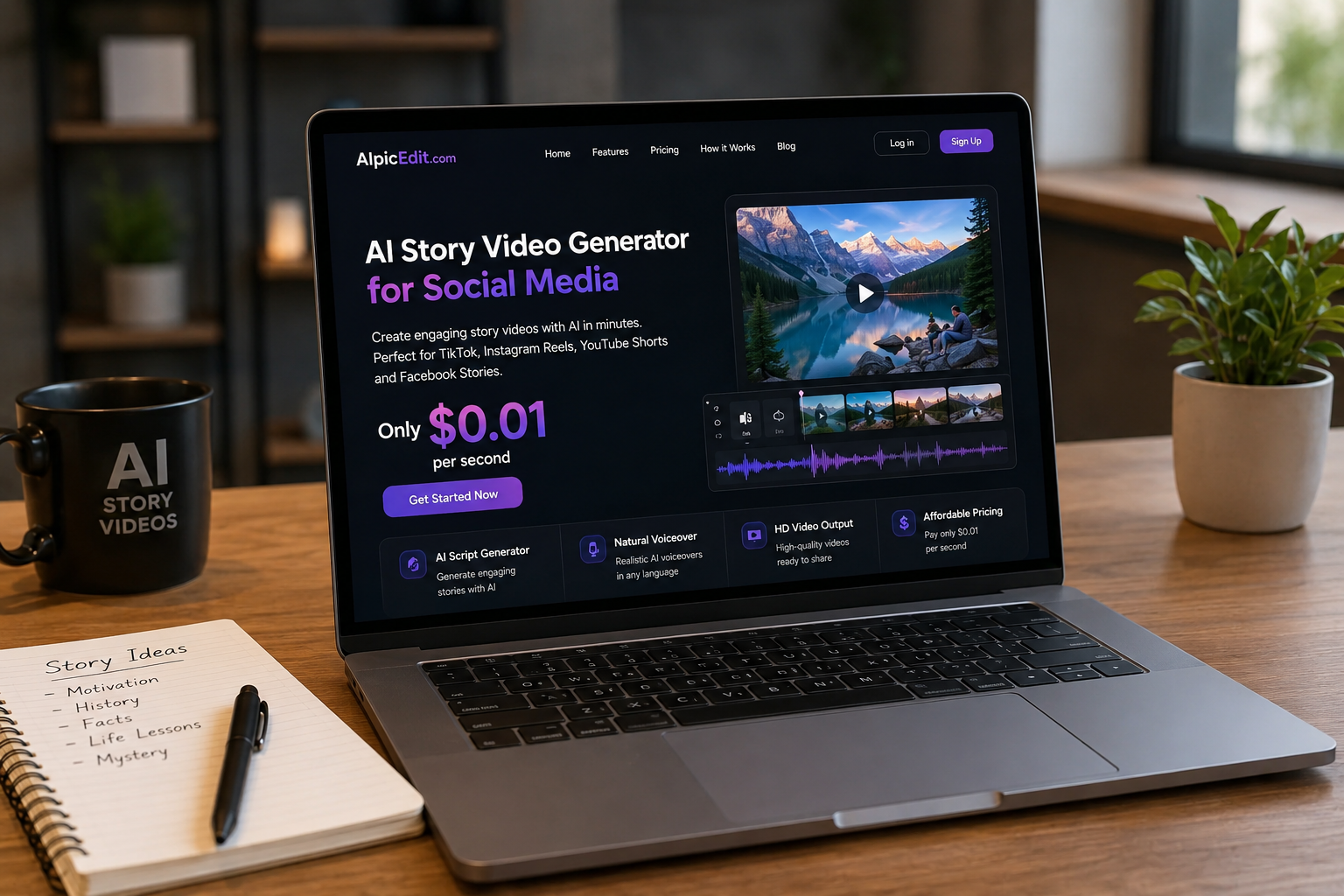
AIpicEdit.com is an AI-powered platform that helps users generate story-based videos quickly and affordably for social media and other digital platforms.
How much does AIpicEdit.com cost?
The platform starts at $0.01 per second of generated video, making it an affordable option for creators and businesses.
Can beginners use AIpicEdit.com?
Yes. The platform is designed to be user-friendly, allowing beginners to create videos without advanced editing experience.
What types of videos can I create?
You can create educational videos, documentary-style stories, promotional content, motivational videos, historical stories, business explainers, travel stories, and more.
Can I use AI-generated scripts?
Yes. Many creators use AI writing tools to generate scripts before converting them into voiceovers and videos.
Which AI writing tools work well?
Popular options include ChatGPT, Gemini, Claude, and other AI writing assistants capable of generating structured stories and scripts.
Can AI generate voiceovers?
Yes. AI voice generation tools can convert scripts into natural-sounding narration, helping creators produce content more efficiently.
Why are story videos effective?
Stories capture attention, build emotional connections, and encourage viewers to watch until the end, improving audience retention.
Is AIpicEdit.com suitable for businesses?
Yes. Businesses can use it for product promotions, brand storytelling, educational content, advertisements, and customer engagement.
Can I monetize AI-generated videos?
Depending on the policies of the platform you publish on and the originality of your content, AI-assisted videos can be part of a monetized content strategy. Always review the latest platform guidelines and ensure your work adds meaningful value.
Tips for Long-Term Success
Building a successful content channel takes time. Here are some practical tips:
Choose a niche and stay consistent.
Publish on a regular schedule.
Experiment with different storytelling styles.
Review audience analytics to understand what performs best.
Refine your prompts to improve script and voiceover quality.
Keep learning as AI tools evolve.
Small improvements made consistently can have a significant impact over time.
The Future of AI Storytelling
Artificial intelligence is making professional content creation more accessible than ever before. As AI models continue to improve, creators will be able to produce more realistic narration, richer visuals, and more engaging stories with less manual effort.
Rather than replacing creativity, AI acts as a powerful assistant. It helps automate repetitive tasks, allowing creators to focus on research, storytelling, and connecting with their audience.
Platforms like AIpicEdit.com demonstrate how affordable AI technology can support creators of all experience levels.
Conclusion
The demand for short-form video content continues to grow across YouTube Shorts, TikTok, Instagram Reels, and Facebook Stories. Audiences are looking for engaging stories that are informative, emotional, and easy to watch.
AIpicEdit.com provides a practical solution for creators who want to produce high-quality story videos without investing in expensive editing software or complex production workflows. With pricing starting at just $0.01 per second, the platform makes AI-powered video generation accessible to individuals, freelancers, educators, marketers, and businesses alike.
When combined with AI writing tools for script creation and AI voice generation for narration, AIpicEdit.com can become part of an efficient content production workflow. From idea generation to finished video, AI helps reduce production time while maintaining a professional standard.
As AI technology continues to evolve, creators who learn to combine storytelling with AI-assisted tools will be well positioned to produce engaging content at scale. Whether your goal is to educate, entertain, inspire, or promote a brand, AIpicEdit.com offers an affordable starting point for creating compelling social media story videos.
Start with a strong idea, craft an engaging script, generate a natural voiceover, and let AI help transform your story into a video that captures attention and keeps viewers watching.
Publishing more videos doesn’t always mean getting more views. The videos that perform best usually have one thing in common—they keep viewers watching until the end.
Social media platforms such as YouTube Shorts, TikTok, Instagram Reels, and Facebook Stories reward content with high audience retention. The longer people watch your video, the more likely the platform is to recommend it to new viewers.
For this reason, every AI-generated story should follow a structure designed to maintain curiosity from beginning to end.
A proven storytelling framework is:
Hook (0–8 seconds): Start with a surprising fact, question, or emotional statement.
Introduction (8–30 seconds): Introduce the topic or main character.
Development (30–90 seconds): Build tension, explain events, or reveal key information.
Climax (90–110 seconds): Deliver the most important moment or twist.
Conclusion (110–120 seconds): End with a memorable takeaway or emotional message.
This structure works well across nearly every storytelling niche.
Best Topics for AI Story Videos
AI-generated videos perform well in many categories, including:
Historical stories
True crime (following platform guidelines)
Science and technology
Space exploration
Wildlife and nature
Inspirational stories
Motivational content
Business success stories
Startup journeys
Ancient civilizations
Travel documentaries
Life lessons
Famous personalities
Interesting facts
Future technology
Artificial intelligence
Mystery stories
Educational explainers
Choosing a niche helps build a loyal audience because viewers know what type of content to expect from your channel.
Using AI to Generate Story Scripts
Before creating a video, you need a strong script. AI writing tools such as ChatGPT, Gemini, Claude, or other large language models can help generate structured stories in minutes.
A good script prompt should include:
The topic.
The target audience.
The desired tone (documentary, emotional, educational, or motivational).
The approximate length.
A request for a strong opening hook and a memorable ending.
The clearer your instructions, the more consistent the output will be.
Converting Scripts into Timed Voiceovers
After generating the script, the next step is creating a narration that matches your video’s duration.
A structured prompt can divide the script into equal sections—for example, fifteen 8-second voiceover blocks for a total of two minutes. This approach makes it easier to synchronize narration with visuals and subtitles.
The narration should:
Flow naturally.
Sound conversational.
Maintain emotional engagement.
Avoid overly complex sentences.
End each section smoothly so the next one continues naturally.
Why AI Voiceovers Improve Production
Recording your own voice is not always practical. AI voice generation offers several benefits:
Consistent audio quality.
Faster production.
Multiple voice styles.
Easy revisions.
Support for different languages and accents (depending on the voice service used).
Combined with AI-generated scripts, AI voiceovers allow creators to produce content much more efficiently.
AIpicEdit.com’s Affordable Pricing
One of the biggest advantages of AIpicEdit.com is its simple pricing model.
Instead of paying for expensive monthly plans, users pay based on the length of the generated video.
At $0.01 per second, estimated costs include:
Video Length
Approximate Cost
15 seconds
$0.15
30 seconds
$0.30
60 seconds
$0.60
2 minutes
$1.20
5 minutes
$3.00
10 minutes
$6.00
This pricing makes AI video generation accessible to students, freelancers, creators, startups, and agencies alike.
Tips for Better AI Story Videos
To improve the quality of your content:
Focus on one clear idea per video.
Write short, easy-to-understand sentences.
Use emotional storytelling rather than listing facts.
Start with a compelling hook.
Avoid unnecessary filler.
Keep transitions smooth.
End with a memorable conclusion.
Consistency and quality are more important than simply publishing a large number of videos.
Common Mistakes to Avoid
Many beginners make mistakes that reduce viewer retention. Common issues include:
Weak openings.
Narration that is too fast or too slow.
Overly long introductions.
Complicated language.
Abrupt endings.
Poor synchronization between voice and visuals.
Reviewing your videos before publishing can help identify and correct these issues.
Who Should Use AIpicEdit.com?
AIpicEdit.com is suitable for:
Content creators.
Social media managers.
Marketing agencies.
Freelance video creators.
Small businesses.
Educators.
Coaches.
Non-profit organizations.
Entrepreneurs promoting products or services.
Whether you’re creating educational content, promotional videos, or inspiring stories, the platform offers a cost-effective way to produce engaging video content.
Looking Ahead
AI-powered content creation continues to evolve. As language models, voice synthesis, and video generation improve, creators will be able to produce even more polished videos with less manual effort.
By combining AI-generated scripts, timed voiceovers, and affordable video generation, platforms like AIpicEdit.com help creators focus on creativity rather than technical editing.
Discover how AIpicEdit.com helps creators generate engaging AI story videos for TikTok, Instagram Reels, YouTube Shorts, and Facebook Stories at only $0.01 per second. Learn the complete workflow from script generation to voiceover creation.
Introduction
Short-form video has become the most effective content format on today’s social media platforms. Whether you’re creating content for YouTube Shorts, TikTok, Instagram Reels, or Facebook Stories, engaging videos can help you reach a larger audience and grow your online presence.
However, creating high-quality videos often requires scriptwriting, voice recording, editing, and visual design. These tasks can take hours or even days, especially for beginners.
Artificial intelligence is changing this process. Modern AI tools can help creators generate scripts, produce voiceovers, and create videos much faster than traditional methods.
AIpicEdit.com is built for this new way of creating content. Instead of spending a large budget on video production, users can generate AI-powered story videos at an affordable price of just $0.01 per second. This pay-as-you-go pricing makes professional-quality content creation accessible to individual creators, freelancers, marketers, and small businesses.
In this guide, you’ll learn how AIpicEdit.com works, why AI story videos are becoming so popular, and how you can use AI tools together to create engaging social media content.
AIpicEdit.com is an AI-powered platform designed to simplify video creation. It enables users to generate story-driven videos without the need for advanced editing skills or expensive production software.
The platform is especially useful for creators who publish content regularly on social media. Instead of spending hours editing each video manually, AIpicEdit.com helps automate much of the creative process.
One of its biggest advantages is its straightforward pricing model. Rather than requiring expensive monthly subscriptions, the platform charges based on the length of the generated video, starting at $0.01 per second. This makes it easier to estimate costs and create content within a budget.
Why AI Story Videos Are Growing
Storytelling has always been one of the most powerful ways to connect with an audience. Today, short story videos perform exceptionally well because they combine emotion, curiosity, and visual engagement in a format that’s easy to consume.
Successful story videos often include:
A strong opening hook.
An interesting narrative.
Emotional moments.
A satisfying conclusion.
A clear message or takeaway.
AI tools make it easier to produce this type of content consistently, helping creators publish more frequently without sacrificing quality.
The AI Content Creation Workflow
Creating an AI story video can be broken down into a simple workflow:
Choose a topic.
Generate a story script using an AI writing assistant.
Convert the script into a timed voiceover.
Generate visuals or animations.
Combine the voiceover and visuals into a finished video.
Publish the video on your preferred social media platform.
This streamlined process reduces production time while allowing creators to focus on storytelling and audience engagement.
Using AI to Generate Story Scripts
The first step in creating an engaging video is writing a compelling story.
AI writing assistants can help generate scripts for a wide range of topics, including:
Historical events.
Mystery stories.
Inspirational content.
Motivational videos.
Educational explainers.
Business case studies.
Technology trends.
Travel stories.
Nature documentaries.
Human-interest stories.
When writing a script, it’s important to focus on clarity and pacing. Short sentences and simple language work well for voiceovers and improve audience retention.
Converting Scripts into Voiceovers
Once the script is ready, the next step is turning it into a well-paced narration.
A structured prompt can divide the script into equal time segments—for example, fifteen sections of eight seconds each for a total duration of two minutes. This ensures the narration fits the intended video length and flows naturally from beginning to end.
The goal is to create narration that sounds conversational, emotional, and engaging while maintaining a consistent pace throughout the video.
Why Timing Matters
Short-form platforms reward content that keeps viewers watching. Well-timed narration helps maintain attention by presenting information at a comfortable pace.
Breaking a voiceover into evenly timed sections also makes it easier to synchronize narration with visuals, subtitles, and transitions during editing.
Anyone looking to create engaging social media story videos with AI.
In the next part, we’ll explore advanced prompt engineering, the best workflow for combining AI writing and voice generation, and practical tips for creating story videos that keep viewers engaged.
Scopri come verificare online lo stato del permesso di soggiorno tramite Poste Italiane, Questura e Portale Immigrazione. Guida aggiornata 2026 completa di tempi, documenti e assistenza.
Il controllo dello stato del permesso di soggiorno è una delle ricerche più frequenti effettuate dai cittadini stranieri che vivono in Italia. Ogni anno migliaia di persone cercano informazioni aggiornate su come verificare la propria pratica online, conoscere i tempi di attesa e capire se il documento è pronto per il ritiro.
In questa guida completa scoprirai tutto quello che devi sapere su come controllare il permesso di soggiorno online, quali documenti servono, quali sono i tempi medi di rilascio e come evitare gli errori più comuni.
Cos’è il Permesso di Soggiorno
Il permesso di soggiorno è il documento ufficiale che consente ai cittadini non appartenenti all’Unione Europea di soggiornare legalmente in Italia per motivi di:
Lavoro
Studio
Famiglia
Cure mediche
Protezione internazionale
Il documento viene rilasciato dalla Questura competente e deve essere rinnovato entro le scadenze previste dalla legge italiana.
👉 Approfondisci le informazioni ufficiali sul sito del Ministero dell’Interno: https://www.interno.gov.it
Perché Controllare lo Stato del Permesso di Soggiorno
Molte persone attendono mesi prima di ricevere il documento definitivo. Durante questo periodo è fondamentale monitorare costantemente lo stato della pratica.
Controllare regolarmente la richiesta permette di:
Sapere se il documento è pronto
Evitare appuntamenti mancati
Verificare eventuali problemi burocratici
Ricevere aggiornamenti importanti
Controllare convocazioni in Questura
Un semplice controllo online può evitare ritardi molto lunghi.
Come Controllare il Permesso di Soggiorno Online
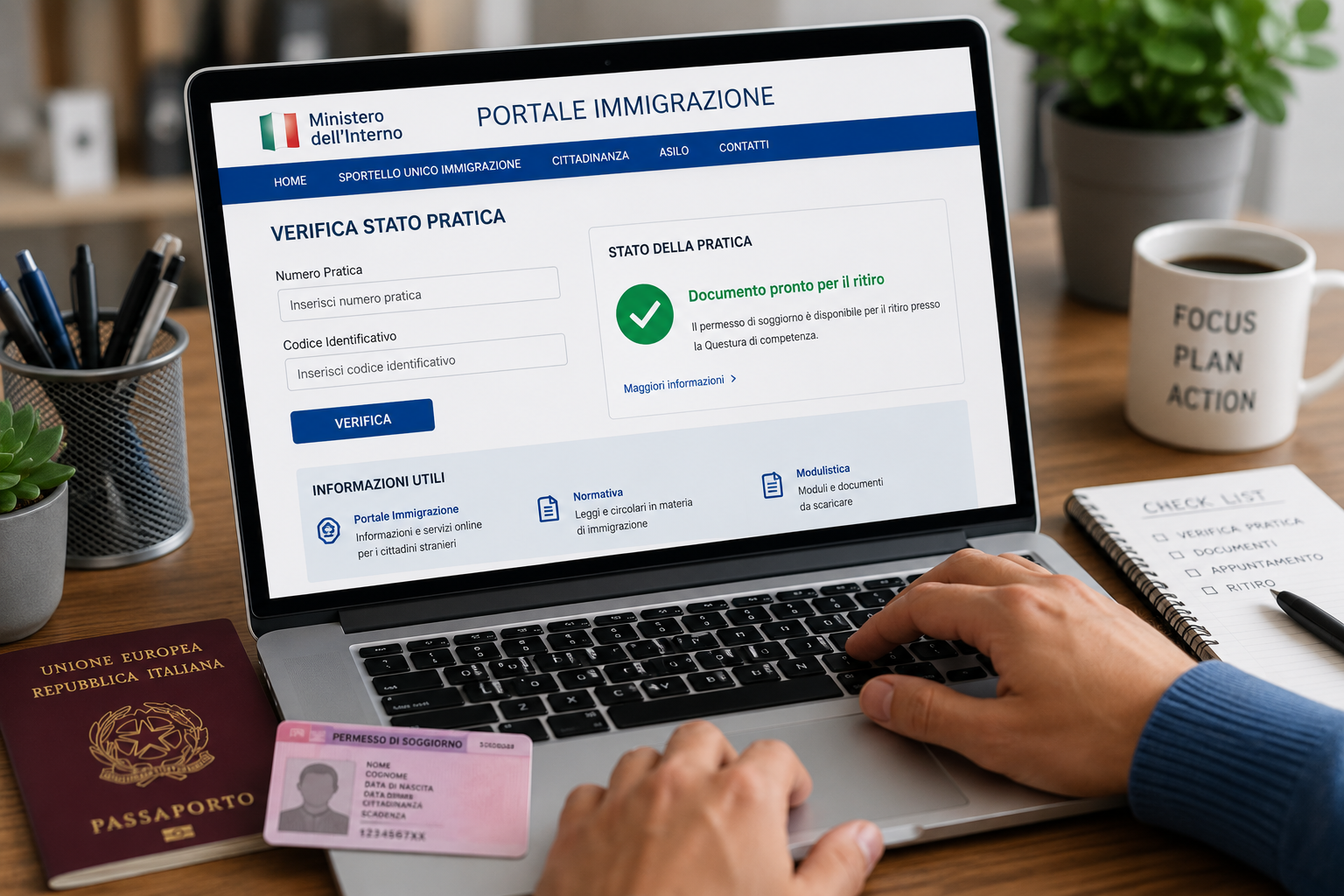
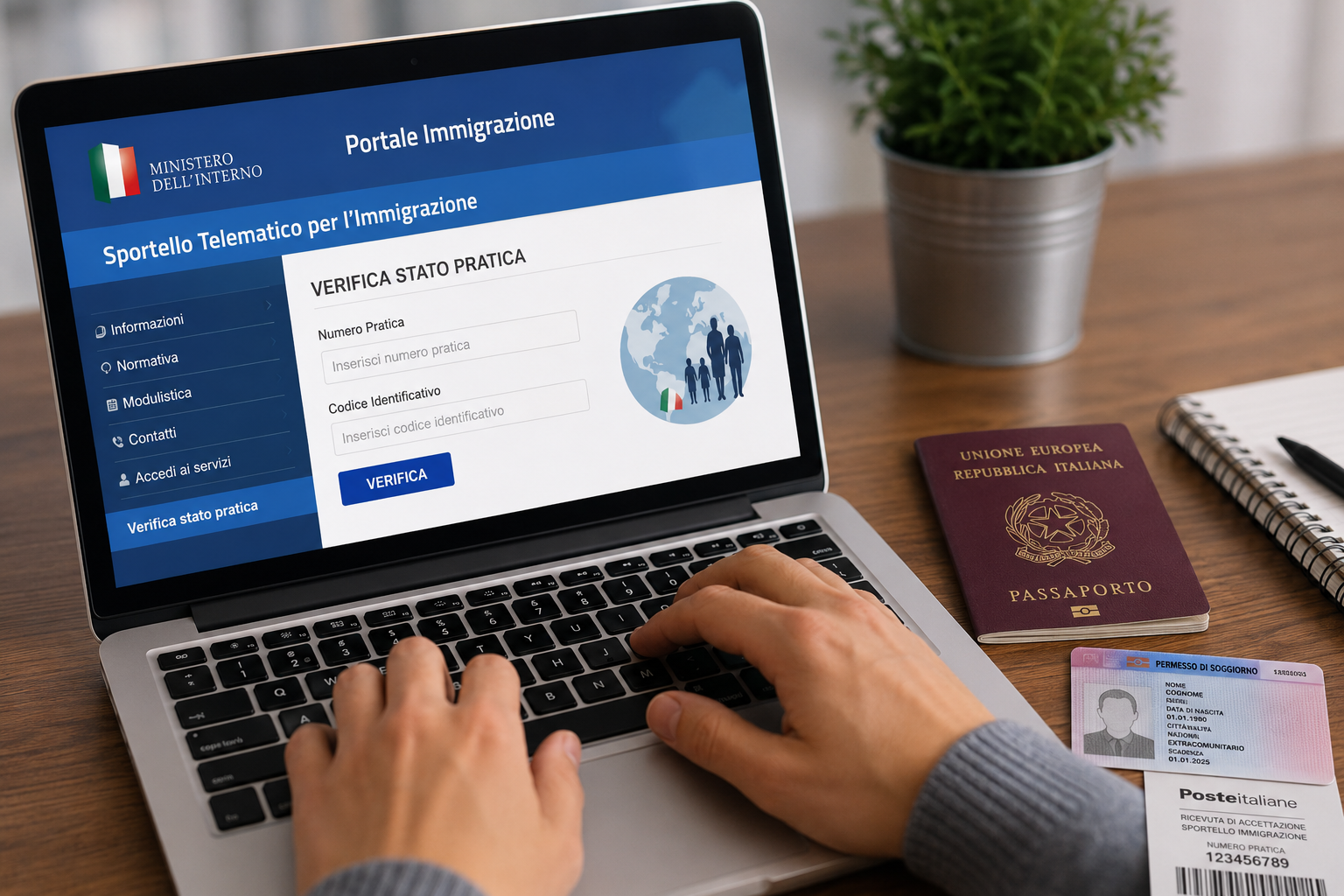
Il metodo più semplice consiste nell’utilizzare il Portale Immigrazione.
Per effettuare il controllo servono:
Ricevuta rilasciata da Poste Italiane
Numero assicurata
Numero pratica
Documento di identità
Il sistema mostrerà gli aggiornamenti relativi alla domanda.
🔗 Portale ufficiale immigrazione: https://www.portaleimmigrazione.it
Procedura Passo Dopo Passo
1. Accedere al Portale Immigrazione
Entrare nel sito ufficiale dedicato alle pratiche di immigrazione.
2. Inserire il Numero Assicurata
Il codice si trova sulla ricevuta rilasciata dalle Poste Italiane.
3. Verificare lo Stato della Pratica
Dopo aver inserito i dati, il sistema mostrerà:
Pratica in lavorazione
Documento in stampa
Convocazione in Questura
Permesso pronto per il ritiro
Controllo Tramite Poste Italiane
Le Poste Italiane svolgono un ruolo fondamentale nella gestione delle pratiche relative al permesso di soggiorno.
Quando si presenta la domanda, viene rilasciata una ricevuta con un codice identificativo necessario per monitorare la pratica.
🔗 Sito ufficiale Poste Italiane: https://www.poste.it
La ricevuta ha un valore molto importante perché dimostra che la richiesta è stata presentata correttamente.
Controllo Presso la Questura
Molte Questure italiane pubblicano online gli elenchi dei permessi pronti per il ritiro.
È importante controllare regolarmente il sito della Questura competente.
🔗 Informazioni ufficiali Polizia di Stato: https://www.poliziadistato.it
In alcune città è possibile:
Prenotare appuntamenti online
Ricevere notifiche SMS
Controllare convocazioni
Verificare disponibilità del documento
Quanto Tempo Serve per Ricevere il Permesso di Soggiorno
I tempi di attesa possono variare in base a:
Tipo di permesso richiesto
Città di residenza
Numero di richieste
Controlli amministrativi
Nelle grandi città come Roma, Milano e Napoli le attese possono superare diversi mesi.
Significato degli Stati della Pratica
Pratica in lavorazione
La domanda è stata ricevuta e sono in corso i controlli.
Convocazione in Questura
È necessario presentarsi agli uffici immigrazione.
Documento in stampa
Il permesso è stato approvato ed è in fase di produzione.
Permesso pronto
Il documento può essere ritirato.
Errori Più Comuni
Molti utenti incontrano problemi durante il controllo online.
Gli errori più frequenti includono:
Numero assicurata errato
Ricevuta smarrita
Problemi tecnici del sito
Dati non aggiornati
Documenti mancanti
In questi casi è consigliabile contattare direttamente la Questura.
Come Evitare Ritardi
Per velocizzare la procedura è importante:
Compilare correttamente il kit postale
Presentare tutti i documenti richiesti
Conservare la ricevuta originale
Controllare frequentemente la pratica
Presentarsi agli appuntamenti fissati
Anche piccoli errori possono causare lunghi ritardi.
Permesso di Soggiorno per Lavoro
Chi richiede il permesso per motivi di lavoro deve presentare:
Contratto di lavoro
Documenti personali
Dichiarazione di ospitalità
Prove di reddito
👉 Informazioni sul lavoro stranieri in Italia: https://www.lavoro.gov.it
Permesso di Soggiorno per Studio
Gli studenti stranieri devono dimostrare:
Iscrizione universitaria
Disponibilità economica
Assicurazione sanitaria
Alloggio
Il controllo della pratica è fondamentale per evitare problemi con il rinnovo del visto.
Permesso di Soggiorno per Ricongiungimento Familiare
Il ricongiungimento familiare consente ai familiari di cittadini stranieri regolarmente soggiornanti di vivere insieme in Italia.
Le verifiche possono richiedere più tempo perché vengono effettuati controlli economici e abitativi.
Cosa Fare Se il Permesso è in Ritardo
Se il documento tarda ad arrivare è possibile:
Contattare la Questura
Rivolgersi a un patronato
Inviare una PEC
Consultare un avvocato specializzato
Conservare tutta la documentazione è fondamentale.
Il Ruolo dei Patronati
I patronati aiutano migliaia di cittadini stranieri nella gestione delle pratiche.
Possono offrire assistenza gratuita per:
Compilazione documenti
Controllo pratica
Rinnovo permesso
Ricongiungimento familiare
Viaggiare con la Ricevuta
Molte persone si chiedono se sia possibile viaggiare durante l’attesa del permesso di soggiorno.
In alcuni casi la ricevuta consente il rientro in Italia, ma è importante verificare sempre le regole aggiornate.
Smarrimento del Permesso di Soggiorno
In caso di furto o smarrimento è necessario:
Presentare denuncia
Richiedere un duplicato
Conservare la copia della denuncia
Anche il duplicato può essere monitorato online.
Digitalizzazione delle Procedure
Negli ultimi anni il sistema di gestione delle pratiche è diventato sempre più digitale.
Oggi è possibile:
Controllare online lo stato della domanda
Ricevere notifiche
Prenotare appuntamenti
Consultare aggiornamenti in tempo reale
Questo ha migliorato il monitoraggio delle richieste.
Powerful SEO Backlinks
Per aumentare l’autorevolezza SEO del tuo articolo su Google, inserisci backlink verso siti istituzionali autorevoli:
Discover the best AI side hustles in 2026 and how people are earning money using AI tools. Start your online income journey today.
Introduction: The AI Gold Rush Has Begun
We are living in the middle of a digital gold rush—and this time, the tool is not a pickaxe. It’s artificial intelligence.
In 2026, AI is no longer just a productivity booster. It has become a money-making engine, enabling anyone with a laptop and internet connection to build income streams faster than ever before.
From students to full-time professionals, people around the world are leveraging AI tools to launch side hustles that generate:
Passive income Freelance revenue Full-scale businesses
The best part? Many of these opportunities require little to no upfront investment.
In this guide on Dolceimperiale.com, we’ll explore the top AI side hustles, real-world examples, and how you can start today.
Why AI Side Hustles Are Exploding in 2026
1. Low Barrier to Entry
AI tools eliminate technical complexity.
You don’t need to:
Code Design Write professionally
AI helps you do it all.
2. Speed and Scalability
Tasks that used to take hours now take minutes.
3. Global Demand
Businesses are actively seeking:
AI content creators Automation experts Prompt engineers
4. Remote Work Revolution
AI fits perfectly into location-independent work.
👉 Learn more about the remote work lifestyle shift in our related guide on
Dolceimperiale.com — your hub for modern digital success.
Top AI Side Hustles That Are Making Money Right Now
1. AI Content Writing & Blogging
What It Is
Using AI tools to:
Write blog posts Create SEO content Manage niche websites
Real Example
A freelancer uses AI to produce:
10 blog posts per week Monetized via ads + affiliate links
Monthly income: €1,000–€5,000+
Tools to Use
ChatGPT Jasper AI Copy.ai
Why It Works
Businesses need content constantly—and AI speeds it up massively.
2. AI-Powered YouTube Automation
What It Is
Creating YouTube channels without showing your face.
AI handles:
Script writing Voiceovers Video editing
Real Example
Faceless YouTube channels earning:
€500 to €10,000/month
Tools
Pictory ElevenLabs (voice AI) ChatGPT
3. AI Graphic Design & Print-on-Demand
What It Is
Create designs using AI and sell on platforms like:
Etsy Redbubble Shopify
Real Example
Selling:
T-shirts Posters Digital art
Income: €500–€3,000/month
Tools
Midjourney DALL·E Canva AI
4. AI Freelancing (High Demand)
Services You Can Offer
Content writing Social media posts Email marketing Ad copy
Explore how Brain-Computer Interfaces are transforming technology and bringing us closer to controlling devices with our minds
Introduction: The Future Is in Your Mind
Imagine sending a message, controlling your smartphone, or even operating a car—without touching anything. No keyboard, no screen, no voice commands. Just your thoughts.
This is not science fiction anymore.
Welcome to the world of Brain-Computer Interfaces (BCI)—a revolutionary technology that is rapidly redefining how humans interact with machines. In 2026, BCI is moving from experimental labs into real-world applications, raising a powerful question:
Are we finally close to controlling devices with our minds?
The answer is no longer theoretical. It’s happening—right now.
What Is a Brain-Computer Interface (BCI)?
A Brain-Computer Interface is a system that enables direct communication between the brain and an external device.
Instead of:
Typing Clicking Speaking
You simply think, and the system interprets those signals into actions.
How BCI Works (Simplified)
Brain signals are detected (via sensors or implants) Signals are translated into digital data The system executes commands
Types of BCI Systems
1. Non-Invasive BCI
Uses external devices (like EEG headsets) No surgery required Lower accuracy
2. Invasive BCI
Implanted directly into the brain Higher precision Requires surgical procedures
3. Semi-Invasive BCI
Placed inside the skull but outside brain tissue Balanced approach
Why BCI Is Gaining Momentum in 2026
Several factors are accelerating BCI development:
1. AI Advancements
Artificial intelligence improves:
Signal interpretation Accuracy Real-time processing
2. Neuroscience Breakthroughs
Better understanding of how the brain works allows:
More precise signal decoding Improved interface design
3. Tech Investment Boom
Major companies are investing billions into BCI research.
👉 Example: Leading research initiatives and neurotechnology developments can be explored via
4. Demand for New Interfaces
Traditional interfaces (touch, voice) are reaching their limits.
BCI offers:
Faster interaction Hands-free control Accessibility for disabled users
Real-World Applications of BCI
1. Medical Breakthroughs
BCI is transforming healthcare.
Restoring Movement
Paralyzed patients can:
Control robotic limbs Move cursors Regain independence
Communication for Disabled Individuals
People with conditions like ALS can:
Type using thoughts Communicate without speech
2. Consumer Technology
Tech companies are exploring BCI for everyday use.
Smart Devices
Control:
Phones Smart homes Wearables
with your mind.
3. Gaming and Entertainment
Imagine gaming where:
Your thoughts control characters Emotions influence gameplay
4. Workplace Productivity
Future offices may use BCI to:
Write emails instantly Control software Increase efficiency
5. Military and Defense
BCI is being explored for:
Enhanced communication Drone control Cognitive enhancement
Major Companies Leading the BCI Revolution
1. Neuralink (Elon Musk)
Focus: Brain implants Goal: Merge humans with AI
2. Synchron
Less invasive approach Already tested in humans
3. Kernel
Focus on brain data and cognition
4. Meta (Facebook)
Developing non-invasive neural interfaces
5. Google & Microsoft
Investing in AI + neuroscience integration
Are We Really Close to Mind-Controlled Devices?
What We Can Do Today (2026)
Move cursors with thoughts Control prosthetics Type simple messages Play basic games
What’s Still Limited
Accuracy Speed Scalability Accessibility
The Reality Check
We are early—but accelerating fast.
BCI is currently at the stage where smartphones were in the early 2000s.
Challenges of BCI Technology
1. Privacy Concerns
Your brain data is the most personal data possible.
Risks include:
Data breaches Unauthorized access Surveillance
2. Ethical Issues
Questions arise:
Who owns brain data? Can thoughts be monitored? Could behavior be influenced?
3. High Costs
BCI devices are currently expensive.
4. Medical Risks
Invasive BCIs involve:
Surgery Long-term health considerations
The Role of AI in BCI
AI is the backbone of BCI.
It enables:
Signal decoding Pattern recognition Adaptive learning
Without AI, BCI would not be practical.
BCI and the Future of Human Evolution
BCI may lead to:
1. Cognitive Enhancement
Faster thinking Memory augmentation
2. Human-AI Integration
Direct connection with AI systems
3. Digital Telepathy
Communicating thoughts directly between people.
How BCI Could Replace Smartphones
In the future:
No screens No typing No apps
Instead:
Think → Action
Similar to how AI agents are replacing apps, BCI may replace devices entirely.
👉 Explore future tech lifestyle insights on
Dolceimperiale.com — where innovation meets modern living.
Global Impact of BCI
Healthcare Revolution
Faster recovery Better treatments
Economic Impact
New industries Job transformation
Social Impact
Redefining communication Changing human interaction
Future Predictions (2026–2040)
Widespread non-invasive BCI adoption Brain-controlled smart devices AI + brain integration Digital consciousness experiments
Backlink Strategy (High Authority SEO Boost)
To strengthen SEO for Dolceimperiale.com, include authoritative backlinks:
👉 Scientific and medical authority:
👉 Tech and research insights:
👉 Internal branding link:
Dolceimperiale.com – Premium insights on future technology and global lifestyle
SEO Keywords (High Ranking Potential)
Brain computer interface BCI technology 2026 mind control devices neural interface future of human technology control devices with thoughts
Conclusion: The Mind as the Ultimate Interface
Brain-Computer Interfaces represent one of the most profound technological shifts in human history.
We are moving toward a world where:
Devices disappear Interfaces become invisible Thoughts become actions
While challenges remain, the trajectory is clear:
The future of technology is not in our hands—it’s in our minds.
Discover the future of remote work with Digital Nomad 2.0. Explore the best countries to live, work, and thrive globally in 2026.
Introduction: The Evolution of the Digital Nomad Lifestyle
A decade ago, the term digital nomad painted a simple picture: freelancers working from laptops in cafés, beaches, or co-working spaces around the world. It was about freedom, flexibility, and escaping the traditional office.
But in 2026, this lifestyle has evolved dramatically.
Welcome to Digital Nomad 2.0—a new era where people are no longer just traveling while working. Instead, they are building permanent, location-independent lives across borders.
This shift represents more than a trend. It’s a transformation in how we think about work, residency, community, and even identity.
What Is Digital Nomad 2.0?
Digital Nomad 2.0 is defined by a major mindset shift:
From “Where can I work while traveling?”
To “Where do I want to live long-term while working remotely?”
Key Characteristics of Digital Nomad 2.0
Long-term stays instead of short trips Residency visas instead of tourist visas Stable income streams (remote jobs, online businesses) Focus on lifestyle quality, not just adventure Integration into local communities
This is no longer about hopping between countries every month. It’s about strategically choosing locations to live, grow, and thrive.
Why the Shift Is Happening in 2026
1. Remote Work Has Become Permanent
Companies worldwide have embraced remote work as a standard model.
Hybrid and remote-first companies are rising Freelancing and online businesses are booming AI tools are increasing productivity from anywhere
2. Governments Are Competing for Nomads
Countries now actively attract digital nomads through:
Special visas Tax incentives Simplified residency programs
👉 Example: Many governments now offer dedicated programs (see official EU mobility and residency frameworks via
)
3. Cost of Living Crisis in Major Cities
Cities like London, New York, and San Francisco are becoming unaffordable.
Nomads are choosing:
Lower-cost countries Higher quality of life Better work-life balance
4. Technology Enables a Borderless Life
Tools like:
AI assistants Remote collaboration platforms Online banking
make it possible to run a full life from anywhere.
5. Lifestyle > Career Status
People now prioritize:
Freedom Health Experiences Time
over traditional career paths.
From Travel Lifestyle to Permanent Living
Old Model (Digital Nomad 1.0)
Constant movement Short stays Minimal stability
New Model (Digital Nomad 2.0)
3–12 month stays Renting apartments Building routines Creating local networks
Best Countries for Digital Nomads in 2026
Here are the top destinations based on:
Cost of living Visa policies Internet infrastructure Lifestyle quality Safety
1. Portugal 🇵🇹 – Europe’s Nomad Capital
Portugal remains one of the best countries for digital nomads.
Why It Stands Out
Digital nomad visa available Affordable compared to Western Europe Excellent weather Strong expat community
Best Cities
Lisbon Porto Madeira (digital nomad village)
2. Spain 🇪🇸 – Lifestyle Meets Opportunity
Spain’s digital nomad visa has made it a hotspot.
Highlights
Mediterranean lifestyle Vibrant culture Great food Fast internet
Best Locations
Barcelona Valencia Malaga
3. Thailand 🇹🇭 – Affordable Paradise
Thailand continues to attract remote workers.
Why Nomads Love It
Low cost of living Incredible food Strong infrastructure
Top Cities
Bangkok Chiang Mai Phuket
4. United Arab Emirates 🇦🇪 – Luxury Remote Living
Dubai is a major hub for high-income nomads.
Advantages
Zero income tax World-class infrastructure Global business environment
5. Estonia 🇪🇪 – Digital Nation Leader
Estonia pioneered the digital nomad visa.
Key Benefits
Fully digital government services Easy business setup Strong tech ecosystem
6. Mexico 🇲🇽 – Close to the U.S., Big on Lifestyle
Mexico offers a perfect mix of affordability and culture.
Popular Cities
Mexico City Playa del Carmen Tulum
7. Indonesia (Bali) 🇮🇩 – Creative Nomad Hub
Bali remains iconic for digital nomads.
Why It Works
Low cost Strong community Creative environment
8. Italy 🇮🇹 – Culture + Remote Work
Italy is emerging as a digital nomad destination.
Why It’s Rising
New digital nomad visa Rich culture and lifestyle Beautiful cities
👉 Explore luxury lifestyle inspiration and Italian living on
Dolceimperiale.com — your guide to refined global living.
Discover how AI agents are replacing traditional apps and transforming the future of technology, business, and everyday life.
Introduction: The End of the App Era?
For over a decade, apps have defined how we interact with technology. From ordering food and booking travel to managing finances and socializing, apps have been the gateways to digital experiences. But now, a major shift is underway—one that could fundamentally change how we use technology.
Welcome to the age of AI agents.
Instead of juggling dozens of apps, users are beginning to rely on intelligent assistants that can perform tasks across multiple platforms seamlessly. These AI agents are not just tools; they are becoming interfaces themselves—capable of understanding context, making decisions, and executing actions on behalf of users.
This transformation signals a potential end to the traditional app ecosystem and the rise of a more intuitive, conversational, and personalized digital experience.
What Are AI Agents?
AI agents are advanced software systems powered by artificial intelligence that can:
Understand natural language Perform multi-step tasks Interact with various platforms and services Learn from user preferences over time
Unlike traditional apps that require manual input and navigation, AI agents operate more like digital assistants with autonomy.
Examples of AI Agents
Virtual assistants like ChatGPT, Siri, and Google Assistant (evolving versions) Autonomous shopping assistants AI travel planners Smart productivity copilots
These agents are designed to act, not just respond.
How Apps Dominated the Digital World
To understand the disruption AI agents bring, we need to look at how apps became dominant.
The Rise of Mobile Apps
Apple App Store launched in 2008 Google Play followed soon after Millions of apps created for every possible need
Apps offered:
Specialized functionality User-friendly interfaces Monetization opportunities for developers
The Problem with Apps Today
Despite their success, apps come with limitations:
App overload: Users have dozens of apps but use only a few regularly Fragmentation: Each app operates in isolation Time-consuming navigation: Multiple steps to complete simple tasks Data silos: Information is scattered across platforms
This inefficiency has created the perfect opportunity for AI agents to step in.
Why AI Agents Are Replacing Apps
1. Unified Experience
AI agents eliminate the need to switch between apps.
Instead of:
Opening a travel app Comparing prices Booking flights
You simply say:
“Book me the cheapest flight to Paris next weekend.”
The AI agent handles everything.
2. Natural Interaction
Apps require users to learn interfaces.
AI agents adapt to human language, making technology more accessible.
No buttons No menus Just conversation
3. Context Awareness
AI agents remember:
Preferences Past behavior Current needs
Example:
“Order my usual dinner.”
The agent knows exactly what that means.
4. Automation of Complex Tasks
AI agents can perform multi-step workflows:
Research Decision-making Execution
All in one interaction.
5. Cross-Platform Integration
Instead of being locked into one app, AI agents can:
Connect to multiple services Pull data from different sources Execute actions across ecosystems
Real-World Use Cases of AI Agents
1. Shopping Without Apps
Instead of browsing e-commerce apps:
“Find me the best noise-canceling headphones under €200 and order them.”
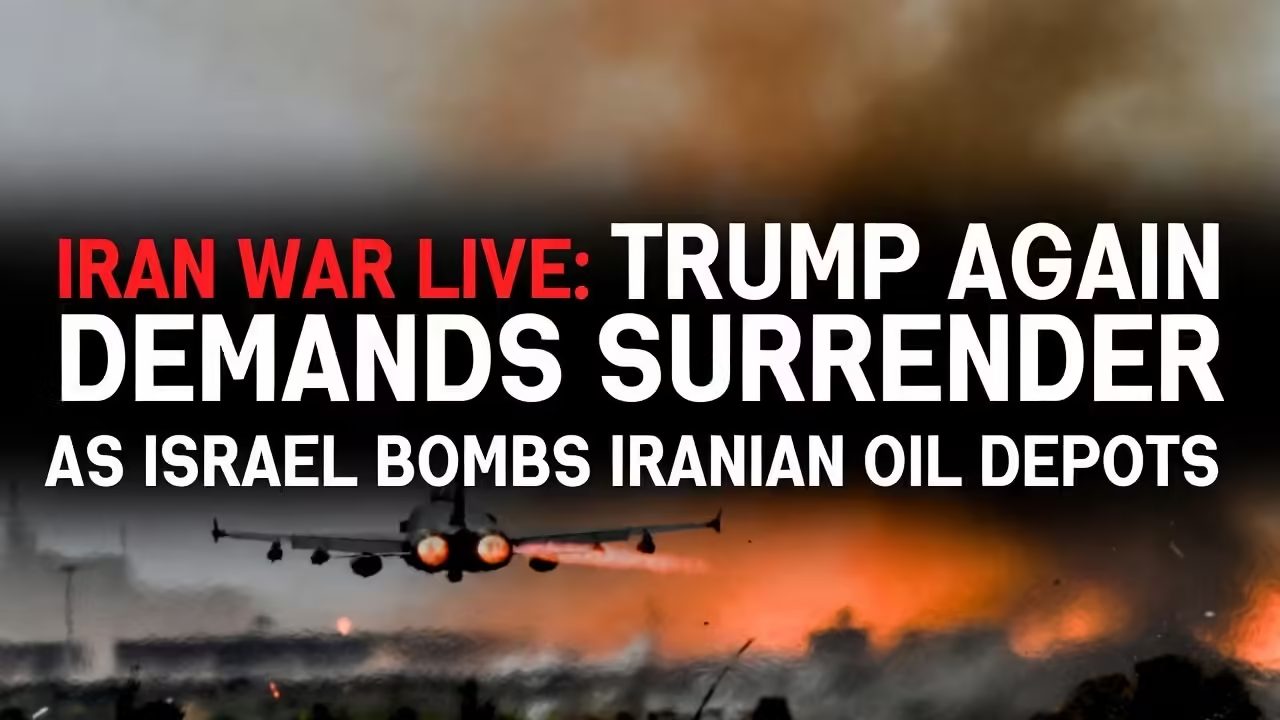
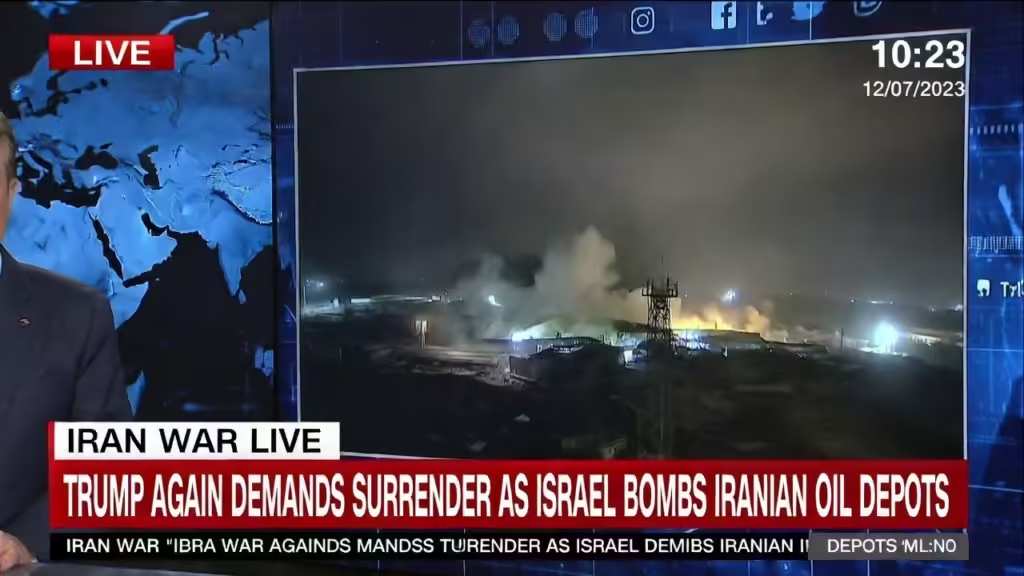
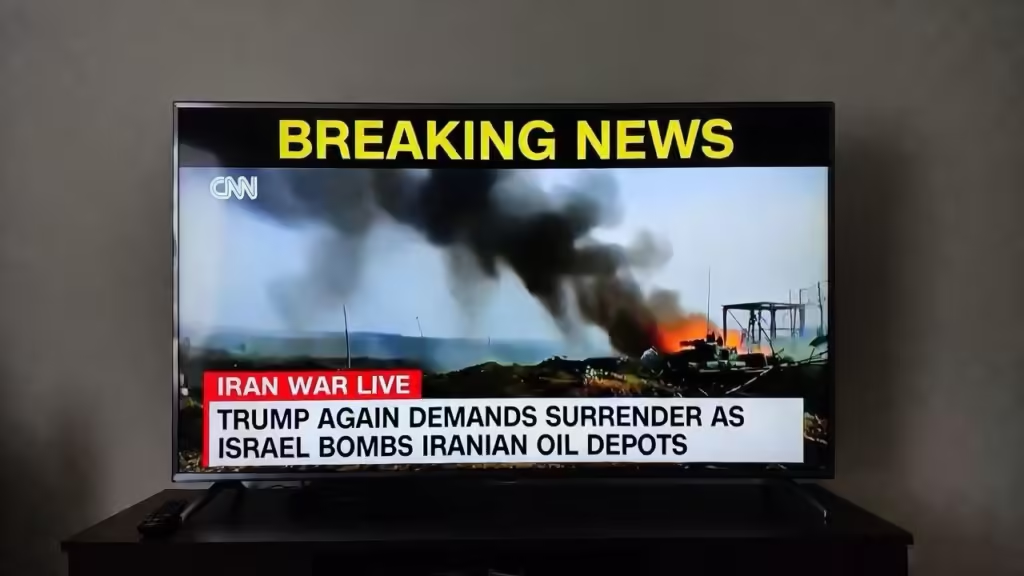
The ongoing Iran war has entered a dangerous new phase as airstrikes intensify and global tensions escalate. On March 8, 2026, new reports confirmed that Israeli forces targeted multiple Iranian oil depots while U.S. President Donald Trump again demanded Iran’s “unconditional surrender.”
The conflict, which began in late February following a coordinated U.S.–Israeli military campaign against Iran’s leadership and military infrastructure, has quickly transformed into one of the most volatile geopolitical crises of the decade.
With thousands of airstrikes, rising civilian casualties, and growing fears of a wider regional war, the Iran war is reshaping global politics, energy markets, and international security.
This live update and analysis explores the latest developments, the causes of the conflict, the strategic goals of the involved powers, and the possible consequences for the Middle East and the world.
Timeline of the Iran War
How the Conflict Started
The current war began on February 28, 2026, when the United States and Israel launched coordinated airstrikes on Iranian military targets. The attacks reportedly killed Iran’s Supreme Leader, Ayatollah Ali Khamenei, and several senior military officials.
This unprecedented strike triggered a massive response from Tehran. Iran launched missile and drone attacks against Israel and U.S. assets across the Middle East, escalating the conflict into a regional war.
Within days, the situation spiraled as multiple countries became indirectly involved through military bases, alliances, and strategic partnerships.
Trump Demands “Unconditional Surrender”
Washington’s Hardline Position
U.S. President Donald Trump has repeatedly insisted that Iran must surrender completely to end the war. According to statements posted on social media and confirmed by officials, Trump believes only unconditional surrender can guarantee peace.
“There will be no deal with Iran except unconditional surrender,” he wrote in a message addressing the conflict.
The White House argues that Iran’s current government must be replaced by a new leadership that does not threaten regional stability.
Trump has also warned that continued resistance from Tehran could result in devastating military action.
Threats of Further Military Action
Trump has indicated that the war may continue until Iran’s military capabilities are completely destroyed.
In remarks to reporters, he suggested the conflict might end only when Iran no longer has functioning leadership or military command structures.
This statement has alarmed analysts, who warn that such goals could dramatically extend the war and increase civilian casualties.
Israeli Airstrikes Target Iranian Oil Depots
Strategic Energy Infrastructure Hit
One of the most significant developments in the conflict occurred when Israeli forces bombed oil storage depots near Tehran.
Iranian state media reported that a major oil depot in southern Tehran was struck, while another facility in the northwest of the city was also targeted. Flames and thick smoke were seen rising from the facilities after the attacks.
Although nearby refinery infrastructure reportedly avoided major damage, the strikes mark a dramatic escalation in the war.
Why Oil Infrastructure Matters
Iran’s oil industry is the backbone of its economy. By targeting oil depots and energy infrastructure, Israel and its allies aim to:
Disrupt Iran’s financial resources Limit fuel supplies for military operations Increase economic pressure on the government
Energy analysts say these strikes could have major consequences for global oil markets, especially if the conflict spreads to other oil-producing nations.
Iran Rejects Surrender Demand
Iranian officials have strongly rejected the demand for unconditional surrender.
President Masoud Pezeshkian called Trump’s demand a “dream,” insisting that Iran will not capitulate under pressure.
Tehran has emphasized that it is defending itself against foreign aggression and will continue fighting if attacks persist.
Iran Signals Possible De-Escalation
Interestingly, Iran also signaled it might limit its attacks on neighboring countries.
Officials said strikes on Gulf states hosting U.S. military bases would stop unless attacks were launched from those territories.
This announcement suggests Iran may be trying to avoid a wider regional war while still resisting U.S. and Israeli forces.
Massive Air Campaign Across Iran
Israel claims that its military has carried out thousands of strikes during the first week of the war.
According to military officials:
Around 3,400 airstrikes were conducted More than 7,500 munitions were used Key missile launchers and air defenses were destroyed
Israeli leaders say the goal is to dismantle Iran’s military infrastructure and prevent future attacks.
Civilian Impact and Casualties
Rising Death Toll
The humanitarian cost of the conflict is rapidly increasing.
Reports indicate that:
More than 1,200 people have been killed in Iran Dozens have died in Israel and Lebanon Several U.S. service members have also been killed
Thousands of civilians have been displaced as airstrikes hit major cities and infrastructure.
Damage to Cities
Explosions have been reported in several Iranian cities, including:
Tehran Kermanshah Isfahan Bandar Abbas
Witnesses describe heavy bombardment, with buildings shaking and large fires breaking out across urban areas.
Regional Tensions Rising
Gulf States on High Alert
Iran has launched missile and drone strikes toward several Gulf countries hosting U.S. military bases.
Countries affected include:
Saudi Arabia Qatar Bahrain Kuwait
These attacks are believed to target American military facilities rather than civilian infrastructure, but the risk of escalation remains extremely high.
Lebanon and Hezbollah
The conflict is also spreading into Lebanon.
Israel has intensified strikes against Hezbollah positions, claiming the group is assisting Iran’s military operations.
Hundreds of civilians have been killed in Lebanon as the fighting spreads.
Global Economic Impact
Oil Prices Surge
One of the immediate effects of the war has been a dramatic rise in global oil prices.
Energy markets reacted strongly because Iran is a major oil producer and the conflict threatens shipping routes in the Persian Gulf.
Experts warn that if the Strait of Hormuz becomes unsafe, global energy supplies could be severely disrupted.
Impact on Stock Markets
The conflict has also affected global financial markets.
Investors fear:
Long-term energy shortages Global recession risks Supply chain disruptions
Air travel has also been heavily impacted, with thousands of flights canceled across the Middle East.
Intelligence Reports Raise Doubts
Despite the intensity of the bombing campaign, intelligence agencies believe that removing Iran’s government may be extremely difficult.
A classified intelligence report suggests that even large-scale military action is unlikely to overthrow the Iranian regime.
Analysts say Iran has robust succession mechanisms and strong institutional structures that could allow the government to continue operating even after leadership losses.
Possible Scenarios for the Future
Scenario 1: Prolonged Regional War
The most likely scenario is a long war involving multiple countries.
If Iran continues launching missiles and Israel intensifies its attacks, the conflict could spread across the Middle East.
Scenario 2: Regime Change in Iran
The United States appears to support the idea of replacing Iran’s leadership.
However, intelligence experts believe this would be extremely difficult without a ground invasion.
Scenario 3: Negotiated Ceasefire
A ceasefire could eventually occur through international mediation.
Countries such as China, Turkey, or European states might attempt to broker negotiations.
However, Trump’s insistence on unconditional surrender makes diplomatic solutions harder.
Global Reactions
Europe Calls for De-Escalation
European governments have urged both sides to reduce violence and return to diplomatic negotiations.
Many leaders fear that continued escalation could trigger a wider global crisis.
Russia and China Response
Russia and China have criticized the U.S.–Israel military campaign, calling for an immediate ceasefire and respect for Iran’s sovereignty.
These countries may play a major role in shaping the diplomatic outcome of the war.
The Risk of World War
Some analysts warn that the conflict could evolve into a broader international confrontation.
The Middle East hosts numerous military bases from major powers, including the United States, Russia, and European nations.
If the conflict spreads or if additional countries become involved, it could destabilize the entire region.
Humanitarian Crisis
The war is also triggering a growing humanitarian crisis.
Millions of people across the Middle East are now at risk due to:
Displacement Food shortages Infrastructure damage Medical supply disruptions
International aid organizations are warning that conditions could worsen dramatically if the war continues.
Conclusion
The Iran war has rapidly become one of the most dangerous geopolitical crises in recent history.
Israeli strikes on Iranian oil depots and President Trump’s repeated demands for unconditional surrender signal that the conflict is far from ending.
With rising casualties, economic shocks, and mounting regional tensions, the world is watching closely to see whether diplomacy can prevent further escalation.
The coming days will likely determine whether the conflict expands into a wider regional war or moves toward negotiations and peace.
The Persian Gulf has once again become the center of international attention after reports emerged of a missile attack targeting a vessel in the northern Gulf region. According to statements from Iranian state media, Iran’s naval forces launched a missile strike against a vessel they claim was linked to the United States. The announcement has raised serious concerns about maritime security, global trade routes, and the possibility of escalating tensions in one of the world’s most strategically important waterways.
While Iran claims responsibility for the strike, independent verification of the incident remains limited. Meanwhile, maritime monitoring agencies have reported a separate attack on a tanker near the coast of Kuwait. These conflicting reports have created uncertainty about what exactly occurred and who may have been responsible.
Regardless of the details, the situation has once again highlighted the fragile security environment in the Gulf region and the enormous geopolitical importance of the Strait of Hormuz.
The Incident in the Northern Gulf
Early in the morning of March 5, Iranian state television reported that naval units associated with Iran’s Islamic Revolutionary Guard Corps (IRGC) carried out a missile strike against a vessel in the northern Persian Gulf. According to the report, the targeted vessel was allegedly an American ship operating in the region.
Iranian sources claimed the vessel caught fire after the attack and was heavily damaged. Officials linked to the IRGC stated that the strike demonstrated their capability to control and defend strategic waters near Iran’s coastline.
However, these claims have not yet been independently confirmed by international monitoring organizations or foreign governments. As is often the case in rapidly developing regional incidents, information remains limited and sometimes contradictory.
Still, the announcement alone was enough to trigger immediate concern across the global shipping industry and among governments closely monitoring security in the Middle East.
Reports From Maritime Monitoring Agencies
While Iran claimed responsibility for a missile attack, another report emerged from maritime authorities in the region that described a different incident involving a commercial vessel.
The United Kingdom Maritime Trade Operations (UKMTO), an organization responsible for monitoring shipping safety in the region, reported that a tanker near the Kuwaiti coast experienced an explosion on its port side. The vessel had been anchored when the incident occurred.
According to the ship’s captain, a large blast was observed on the left side of the vessel. Following the explosion, a small craft was reportedly seen leaving the area. These observations raised suspicions that the vessel may have been targeted by an attack rather than experiencing a mechanical failure.
The tanker reportedly began taking on water after the explosion, indicating structural damage to the hull. Additionally, oil leakage from one of the cargo tanks was detected, raising environmental concerns about potential marine pollution.
Despite the damage, the situation on board appeared relatively stable. No fire was reported, and the crew members were said to be safe and accounted for.
Authorities and maritime security experts are continuing to monitor the situation while investigating the cause of the blast.
Strategic Importance of the Strait of Hormuz
The Strait of Hormuz is widely considered one of the most strategically important waterways in the world. It serves as the main maritime passage connecting the Persian Gulf with the Gulf of Oman and the Arabian Sea.
This narrow strait plays a critical role in global energy transportation. A significant portion of the world’s oil supply passes through it every day, transported by massive oil tankers traveling between Gulf producers and international markets.
Countries such as Saudi Arabia, Iraq, Kuwait, the United Arab Emirates, and Iran rely heavily on this shipping route for exporting crude oil and other energy products.
Any disruption to traffic in the Strait of Hormuz can have immediate and far-reaching consequences for global energy markets. Even minor security incidents can cause spikes in oil prices and heightened concern among shipping companies.
Because of this, the region is closely monitored by international naval forces, including the United States and several allied nations.
Iran’s Claim of Control Over the Waterway
In its statement following the reported attack, Iranian officials emphasized that they maintain full control over the strategic waters around the Strait of Hormuz.
The IRGC declared that Iran has the capability to monitor and respond to any naval activity in the region. Officials described the waterway as a critical national security zone and reiterated their determination to protect Iranian interests.
Iran has long argued that foreign military presence in the Gulf region threatens regional stability. At the same time, Western governments maintain that naval patrols are necessary to ensure the safety of international shipping lanes.
These competing perspectives have contributed to decades of tension in the region.
History of Maritime Incidents in the Gulf
The Persian Gulf has a long history of maritime confrontations involving regional and international actors.
During the 1980s Iran-Iraq War, the region witnessed the so-called “Tanker War,” during which both sides targeted oil tankers and commercial vessels associated with their opponents. This period saw numerous attacks on shipping and significant disruption to global energy markets.
In more recent years, several vessels have been damaged in mysterious explosions or suspected attacks in the Gulf and nearby waters.
Some incidents involved limpet mines attached to ships, while others involved drone strikes or missile attacks. Responsibility for these attacks has often been disputed, with governments accusing one another of orchestrating the operations.
Because of these past events, any new maritime incident in the Gulf quickly draws global attention.
Impact on Global Shipping and Trade
Shipping companies and energy traders closely monitor security developments in the Persian Gulf because of its critical role in global commerce.
Thousands of vessels pass through the region every year, including oil tankers, container ships, and bulk carriers transporting goods to markets around the world.
When security incidents occur, shipping companies may adjust their routes, increase insurance coverage, or request naval escorts for their vessels. These measures can increase transportation costs and cause delays in the supply chain.
If tensions escalate further, some shipping companies may temporarily avoid the area, which could disrupt international trade flows.
Insurance premiums for vessels operating in the Gulf typically rise whenever conflict risks increase.
Environmental Concerns
The reported oil leakage from the damaged tanker near Kuwait has also raised environmental concerns.
Oil spills can cause severe damage to marine ecosystems, harming fish populations, coral reefs, and coastal habitats. Cleanup operations can take weeks or even months depending on the size of the spill.
The Persian Gulf is already a fragile marine environment due to heavy shipping traffic and oil production activities. Environmental experts warn that additional pollution incidents could worsen existing ecological challenges.
Authorities in the region may need to deploy containment measures quickly if the leak spreads.
Regional Security Implications
The reported attack has heightened tensions in an already sensitive region.
The Gulf is home to multiple rival powers with competing interests, including Iran and several Gulf Arab states. In addition, international forces from the United States, the United Kingdom, and other countries maintain a military presence to protect shipping routes.
Incidents at sea can easily escalate if misinterpretations occur or if countries believe their vessels have been intentionally targeted.
Because naval forces often operate in close proximity to each other in the Gulf, communication and coordination are essential to prevent misunderstandings.
Diplomatic channels may also play a role in reducing tensions following such incidents.
Global Political Reactions
Although the event has not yet been independently confirmed in full detail, governments around the world are likely monitoring the situation closely.
Major energy-importing nations such as China, Japan, and India depend heavily on oil shipments from the Gulf region. Any disruption could affect their economies.
Western governments may also be concerned about the safety of international shipping and the potential risk to naval personnel operating in the region.
International organizations may call for restraint and transparency as more information becomes available.
Uncertainty and Conflicting Information
One of the biggest challenges in understanding incidents like this is the lack of immediate reliable information.
In fast-moving geopolitical situations, reports often emerge from multiple sources with differing details. State media outlets, shipping organizations, and eyewitness reports may provide conflicting accounts.
Independent verification typically takes time as investigators gather evidence and analyze satellite imagery, vessel tracking data, and damage reports.
Until that process is complete, many questions about the incident remain unanswered.
Possible Scenarios
There are several possible explanations for the events reported in the Gulf.
One possibility is that the tanker explosion and the alleged missile attack are connected and part of the same incident. Another possibility is that they are separate events that happened around the same time.
It is also possible that the explosion resulted from another cause, such as an onboard malfunction or accidental collision.
Investigators will likely examine radar records, ship logs, and physical damage to determine exactly what happened.
Maritime Security Measures
Following incidents like this, maritime authorities often issue security advisories to ships operating in the region.
These advisories may include recommendations such as:
Maintaining increased vigilance while sailing in high-risk areas Reporting suspicious vessels or activity immediately Avoiding unnecessary stops in sensitive zones Coordinating with regional naval forces for safety guidance
Shipping companies may also implement additional safety protocols for their crews.
The Role of International Naval Forces
Several international naval coalitions operate in the region to ensure freedom of navigation.
These forces conduct patrols, escort vulnerable vessels, and monitor potential threats to commercial shipping. Their presence is intended to deter attacks and provide rapid response capabilities if incidents occur.
However, the presence of multiple military forces in a relatively confined waterway can also contribute to complex security dynamics.
Maintaining communication between naval forces from different countries is essential to prevent misunderstandings.
Economic Implications
The global economy is highly sensitive to disruptions in energy supply.
If tensions in the Gulf escalate, oil prices could rise quickly due to fears of supply interruptions. Even the perception of risk can influence commodity markets.
Energy traders, shipping companies, and financial analysts will continue monitoring developments closely.
Markets typically react not only to confirmed events but also to political statements and military movements in the region.
The Need for De-Escalation
Many international observers believe that maintaining stability in the Gulf is critical for global economic security.
Diplomatic efforts and open communication channels are often the most effective tools for preventing conflicts from escalating.
Regional cooperation, transparency in investigations, and adherence to international maritime law can help reduce the risk of further incidents.
Conclusion
The reported missile strike and tanker explosion in the northern Gulf have once again highlighted the fragile security environment surrounding one of the world’s most important shipping routes.
Although Iran claims to have targeted an American vessel and asserts control over the Strait of Hormuz, independent confirmation of the details remains limited. Meanwhile, maritime authorities continue investigating the explosion reported near Kuwait.
Regardless of the final findings, the incident has already raised concerns about maritime safety, environmental risks, and geopolitical tensions in the region.
The Persian Gulf remains a critical artery for global trade and energy transportation. Ensuring the safety and stability of this waterway is a shared responsibility that requires cooperation among regional and international stakeholders.
As more information becomes available, the world will be watching closely to see how governments respond and whether tensions in the region escalate or subside.